AI automation for startups has one rule that matters more than the rest: do not automate a process you have not finished inventing. Early teams change how they sell, onboard and support every few weeks. A tool built around last month’s process becomes this month’s chore. The good news is that startups also have chores that repeat unchanged, and those are where a small AI tool or internal tool earns its keep. We build them, and a person approves what they do.
Three boxes before any tool
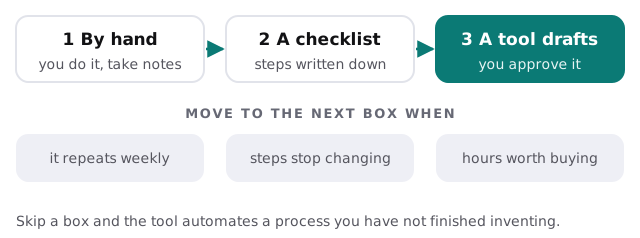
If you can describe the chore in a short checklist and two people would do it the same way, it is ready for a tool. If you cannot, keep doing it by hand and write down what you learn.
What changes by stage
| Stage | The pressure | A good first build |
|---|---|---|
| A handful of people, first customers | The founder is the support desk, the sales team and the bookkeeper | A support inbox that drafts replies from your own docs |
| First real revenue | Customers start sending security and vendor forms | An answer bank for questionnaires |
| Raising or reporting | Investors want a monthly update | A draft update built from your tools’ exports |
| First ten hires | Hiring and onboarding eat the calendar | Interview scheduling and an onboarding checklist |
The questionnaire that arrives with the contract
Enterprise buyers send security and vendor questionnaires, and the questions overlap heavily. Someone, usually a founder, answers them again every time. A tool can hold a bank of answers you have approved, match each incoming question to one and mark the rest for a person.
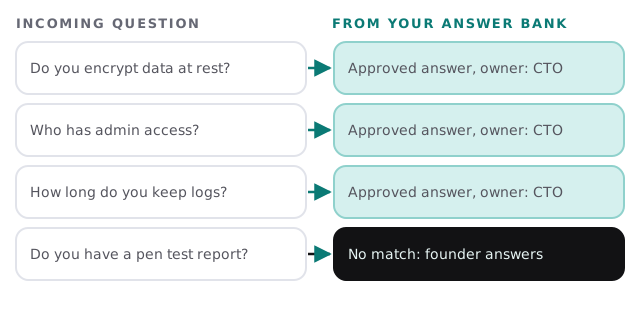
The tool does not invent a claim. An answer it cannot source from your own documents goes to a human. We never write that you hold a certification or pass an audit unless you do, and we would not draft one for you.
A monthly update that writes its own first draft
Investor updates draw on billing, bank balance, a CRM and product analytics. A tool can collect exports, put the numbers in a consistent table and draft the paragraph around them. You write the part that matters: what happened, what you need and what worries you.
The support inbox
At small scale, support is a founder’s best source of product insight, so we would not remove them from it. We would help with the volume: draft replies from your help docs, tag every message by topic and show a weekly digest of what customers keep asking. You read the digest and fix the thing.
Hiring and the first week
Scheduling interviews, collecting feedback and sending the same onboarding links to every new hire can all be drafted or tracked. Decisions about people, pay and fit stay with you.
What to leave alone for now
- Anything that touches money movement or customer billing without a human check.
- Processes that changed in the last month.
- Customer conversations where a founder’s voice is the product.
The tools around a young company
You likely run a shared inbox, a CRM or a spreadsheet pretending to be one, a billing platform, a code host, a docs tool, a chat app and some analytics. Most have exports or integrations. We start by listing which ones can feed a small internal tool.
Your calendar
Fundraising periods, a big customer’s procurement and the month before a launch each squeeze the same few people. Build in the calm weeks, and keep the first project small enough to finish before the next crunch.
What we need from you
Name the chore you would most like gone, the last example of it and the tools involved. After the free IT check you get a plan and a fixed quote. A real person replies within 1 business hour, Monday to Friday, 9am to 5pm Pacific. To start on your own, writing an AI use policy for your small business is a sensible first document.
A startup’s scarcest resource is a founder’s attention. Spend it on the product, and let drafts handle the rest.