AI automation for title companies is not about speed alone. A closing involves several parties, a lender’s deadline and a large sum of someone else’s money, so the useful tools are the ones that keep every file’s status visible and force the safe step to happen. We build small AI tools and internal tools for the work around your title production software, and every message and every release of funds stays with a person.
One question per file: what is it waiting for?
Open files multiply, and each one is waiting on something different: a payoff from a seller’s lender, a homeowners association statement, a signed affidavit, an answer from an agent. A closer keeps this in their head or on a sticky note.
A tool can read the order, the contract and the mailbox thread, and list for each file what is received, what is outstanding and who owes it. The closer sees one screen in the morning, sorted by closing date. For each missing item the tool drafts the request, in your usual wording, for the closer to send.
The three-business-day wait
Federal regulation requires the lender to make sure the borrower receives the Closing Disclosure no later than three business days before closing, as set out in 12 CFR 1026.19(f) for the loans it covers. Three kinds of change restart that wait: the APR becomes inaccurate, the loan product changes or a prepayment penalty is added.
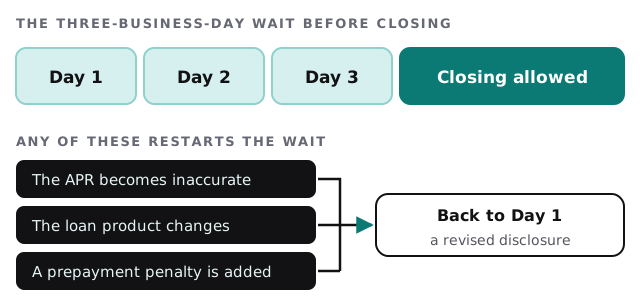
For a title company, the practical consequence is that settlement figures need to be right and early. A tool can compare the latest figures with the version the lender has, flag any difference and give the closer a short list before the file goes out. It does not decide what counts as a change that restarts the clock, and we do not claim any tool makes a file compliant.
Wires: the step that must not be skipped
Fraudulent wire instructions are a known risk in real estate, and a convincing email is how they usually arrive. A tool can hold every wire request until a call-back has been logged.
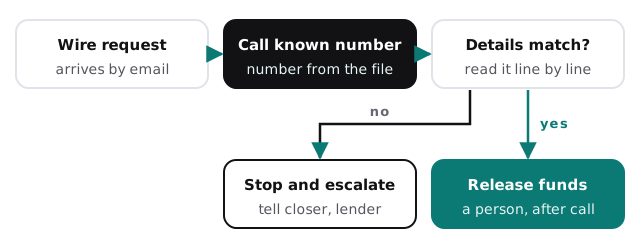
The tool cannot make the call. It makes sure someone did, and it keeps a record you can show later.
Who does what
| Person | Daily weight | What a tool prepares |
|---|---|---|
| Closer or escrow officer | Open-file follow-up | A status list per file with drafted requests |
| Examiner or title officer | Requirements and exceptions | A document packet and a list of open items |
| Accounting | Disbursement and reconciliation | A reconciliation check against the closing figures |
| Front office | New orders | An order checklist built from the contract |
| Recording team | Post-closing tracking | A list of what has been sent and not yet returned |
After the closing
Recording confirmations, final policies and returned documents trail in for weeks. A tool can match what comes back to the file and list the outstanding ones so nothing is forgotten. It can also draft a short thank-you or follow-up to the agent, which keeps a referral source warm.
Month-end and quarter-end
Closings often bunch toward the end of the month. Reconciliation, trust-account tie-outs and your lender relationships pile on at once. A tool can prepare the reconciliation sheet. The accountant signs off.
The software around a title company
Most run title production and escrow software, an escrow accounting system, e-recording, a document portal, scanning and e-signing, plus email and phones. We start by listing which of these can export data without touching the system of record.
Questions to ask any provider
- Does the tool ever send anything without a person reading it?
- Where are borrower and seller documents stored, and who can see them?
- How is a wire request held, and who releases it?
- What happens when two figures disagree?
What we need from you
A sample of anonymized files, your closing checklist and the names of your systems. After the free IT check you get a plan and a fixed quote. A real person replies within 1 business hour, Monday to Friday, 9am to 5pm Pacific.
In a closing, the best automation is a reminder that someone had to pick up the phone.