AI automation for cleaning companies is about the part of the business that isn’t cleaning: the quote request that arrives at 9pm, the crew lead who texts ten photos, the call-out at 6am that blows up the day. The work in the buildings is physical. The work around it is paperwork, and the owner usually does it after the crews go home.
We build small AI tools and internal tools around the systems you already use. A person in your office approves anything a client sees.
Residential and commercial are two different businesses
| Home cleaning | Office and janitorial | |
|---|---|---|
| Typical rhythm | Weekly or biweekly visits to many homes | Fixed nightly or weekly scope at fewer sites |
| What goes wrong | Last-minute cancels, key access, “you missed a spot” | Missed nights, supply shortages, contract scope arguments |
| Quote driver | Size of the home, extras, frequency | Floor area, frequency, restroom count, special surfaces |
| Where AI helps first | Quote replies and rescheduling | Checklists, issue logs and inspection reports |
A good tool is built for one of these, not both. Tell us which you are, or which side you want to grow. Staff turnover is the thread through both: when crews change often, written checklists and photo records are what keep the standard from walking out the door with the last cleaner.
From a web form to a draft quote
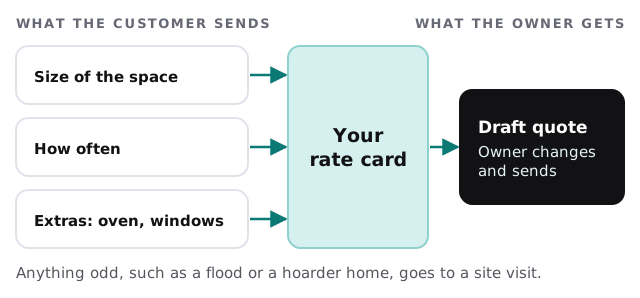
Most inquiries are the same four or five questions in a different order. The tool reads the form or the email, applies your own rate card and rules, and drafts the reply with a clear scope: what’s included, how often and what counts as an extra. Anything that sounds unusual, such as heavy clutter, water damage or an odd building, is flagged for a site visit rather than priced.
What a crew lead’s day becomes
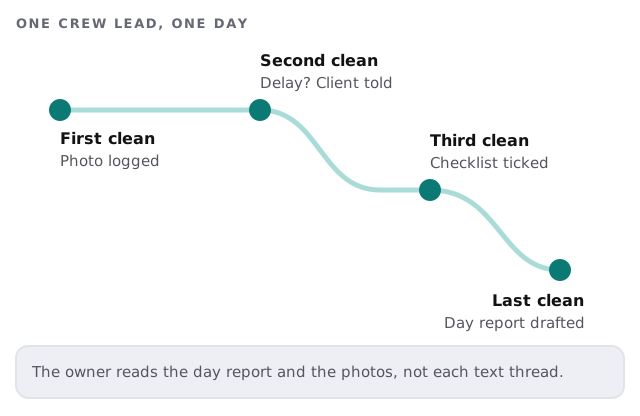
Crew leads aren’t writers and shouldn’t have to be. A photo and a few words become a checklist tick. A delay becomes a drafted note to the client for the office to send. If a client reports a miss, the original photos and the checklist are one click away.
Chores the office could stop doing by hand
- Rescheduling. When a cleaner calls out, the tool lists who’s available and nearby, and drafts the swap messages. The office picks.
- Client reminders. Visit confirmations and “we’re running late” notes, drafted from the schedule.
- Supply counts. Crew leads report what’s low; the tool builds a short order list.
- Inspection reports. For commercial accounts, a monthly summary built from issue logs and photos.
- Review requests. Sent to happy clients only, after the office agrees.
The software around a cleaning business
- Booking and scheduling. A field service or cleaning-specific platform holds clients, visits and invoices.
- Time tracking and payroll. Hours worked per crew and site.
- Accounting. Bookkeeping software for invoices and payments.
- Texting. Where most client and crew communication really happens.
We don’t say we’ve integrated any product by name. If a simple connection is enough, setting up Zapier for your team shows how to turn a web form into a row in a sheet and a reply draft.
Tuesday at 6am
A cleaner texts that she’s sick. By 6:10 the office has a short list: three people free that morning, ranked by who is closest to the first stop, and a drafted message for each. The manager picks one and sends. A client’s morning visit isn’t cancelled, and nobody had to scroll through a group chat.
What we need from you
Your rate card and rules, a typical week’s schedule, the systems you use, and the two chores you dread. We return a plan and a fixed quote after the free IT check. A real person replies within 1 business hour, Monday to Friday, 9am to 5pm Pacific.
A clean building is the product. Everything else, from the quote to the invoice, is overhead a tool can carry.