Managed IT services for physical therapy clinics are judged by the schedule. Patients return several times in a plan of care, visits run close together and every visit needs a note. A slow tablet at 10:40 doesn’t just irritate a therapist. It pushes back the next four people.
The count that nobody should do by hand
A plan of care often comes with an authorized number of visits. Somebody has to know how many have been used, and when to ask for more.
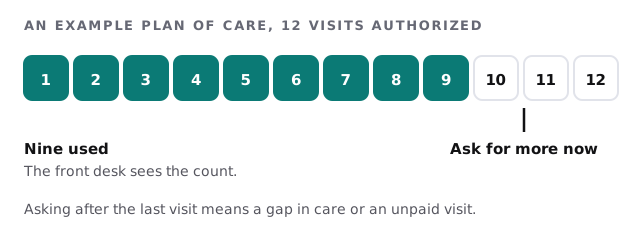
When the count lives in a personal spreadsheet, it is only right until the person is sick. We look at how your practice management or billing software tracks visits and whether the front desk gets a warning in time. If your system can’t do that, we write down the workaround and who owns it.
Notes while the patient is still warm
Documentation is the hidden half of the workday. Where and when notes get written changes how long the day feels.
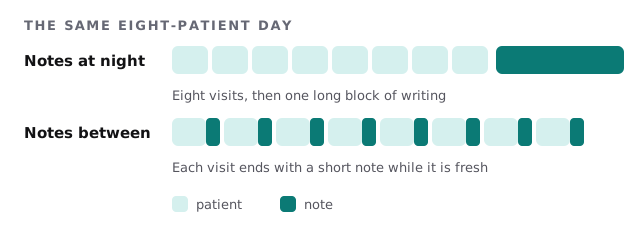
For notes between patients, the technology has to be fast and boring. That means Wi-Fi that covers the gym floor and the corners of the treatment rooms, tablets that wake instantly, a charging shelf where therapists can reach it and a chart that opens in seconds.
What’s on the gym floor
- Tablets or laptops on carts, locked when set down.
- Exercise video and program software, so patients leave with a plan they can follow.
- Modality equipment with its own controls, often from a separate maker.
- A music or TV system that shouldn’t share a network with patient records.
- A check-in kiosk or tablet for the front, with nothing else installed.
The record system, the guest Wi-Fi and the equipment should live on different networks, so a visitor’s phone never sits beside a patient chart.
Home exercise programs
Patients get a program on their phone or in an email. Treat that as a messaging channel, because it often carries a name and a diagnosis. Choose one approved way to send programs. Decide what goes in the message and what stays in the chart, and keep staff from using personal texting for the purpose.
What the Security Rule asks for
For a practice that is a covered entity, the HIPAA Security Rule’s administrative safeguards call for an accurate and thorough assessment of risks to electronic health information, and for a contingency plan made of a data backup plan, a disaster recovery plan and an emergency mode operation plan. We explain those headings in plain words and handle the technical parts, such as listing your systems, backing them up and testing a restore. We never say that a practice or a tool is compliant.
Questions to ask any IT provider
- How quickly does a tablet get replaced when one fails mid-day?
- Who tests the backup, and when did they last restore something?
- What happens when a therapist leaves, from account to device to messages?
- How do you handle updates around our busiest hours?
What we need from you
- Your practice management and charting tools, and who administers them.
- A floor plan marking where devices sit and where the Wi-Fi is weak.
- Your busiest weekday hours.
- How patients receive exercise programs.
Monthly care covers access controls, backups and updates. We start with the free IT check, which ends in a plan and a fixed quote.
A clinic runs on minutes between patients. IT should give them back, not take them.