Plenty of small businesses have tried an AI chat window and then asked the obvious next question: can it just do this inside our own system? That is what Claude API integration services are for. Instead of copying text between a browser tab and your software, we connect your software to Claude directly, which is also what people mean when they search for an Anthropic API developer. The result looks like a feature of your own tool, not a separate website your staff must remember to open.
Who does what in a single request
The part that surprises most buyers is where the work actually happens. Anthropic’s documentation describes tool use this way: Claude returns a structured request, and for tools you define, your application runs it. Claude never reaches into your database. Your code does, and Claude only sees what your code chooses to send back.
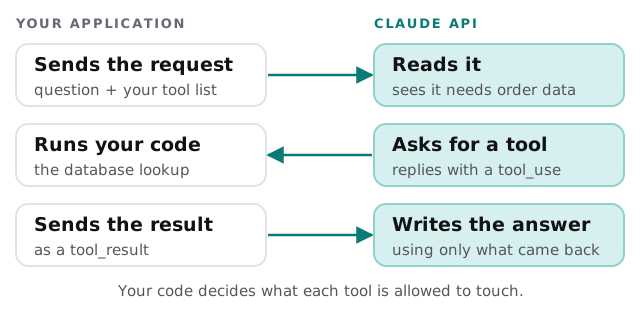
| Claude does | Your code does |
|---|---|
| Reads the request and your instructions | Decides which records may be sent at all |
| Chooses whether a tool is needed | Runs the lookup or the action itself |
| Writes the draft, summary or answer | Checks the output against your rules |
| Asks for another tool if it needs more | Stops after a set number of steps |
The four jobs we usually wire up
- Reading and sorting. Incoming emails, forms or documents are classified and summarised, so a person starts from a clean list instead of a pile.
- Drafting. Replies, quotes, reports or notes are written from your records in your tone, then waiting for review.
- Lookup. A question such as “where is order 4412?” is answered by calling a tool that checks your system and quoting what it found.
- Extraction. Names, dates and amounts are pulled out of messy text and put into the right fields.
Each of these is small on purpose. A narrow job is easier to test, cheaper to run and simpler to trust.
What we build around the call
The API call is the easy ten percent. The rest is what makes it safe to leave running.
Rules your code enforces
Anthropic offers a strict mode for tool definitions so that calls match the schema you wrote. We use it, and we still validate the inputs ourselves, because a well-formed request can still ask for the wrong thing.
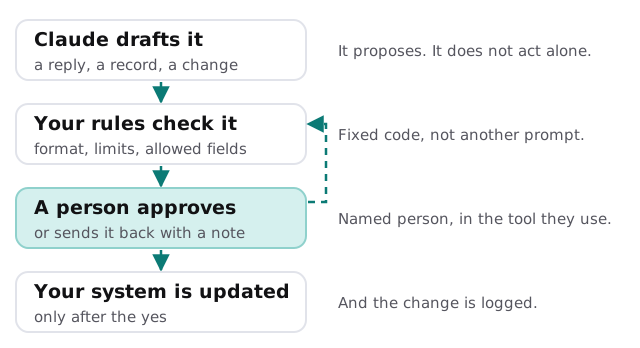
A gate before anything changes
Logs you can read
Every request records what was asked, which tools ran and what came back. When something looks odd on a Thursday, you can open the log and see exactly why.
Questions to ask any provider
- Which parts run on my side and which on the vendor’s?
- What data leaves my systems on each request?
- What happens when the API is slow or unavailable?
- Who approves a change before it is written?
- How do I see what the assistant did last week?
Rather build it yourself?
If you want Claude as an assistant for your people before you commit to a build, our guide to setting up Claude for your team walks through it. We also write about ChatGPT integration for small business, which follows the same pattern with a different model. Come to us once the job has to live inside your own system.
What we need from you
- One job described in a sentence, with three real examples.
- Read access to the system where the information sits.
- The name of the person who will review the output.
We begin with a plan and a fixed quote, and a person approves each action before it touches your real data.
The model is the smallest part of the project. The rules around it are what you are paying for.