Missed calls are quiet losses. A caller who gets voicemail at 12:10 on a busy Tuesday often just rings the next business on the list. An AI receptionist for small business is built for that gap: it picks up, finds out what the person needs, and either handles it or hands it to you with the details already written down.
What happens when the phone rings
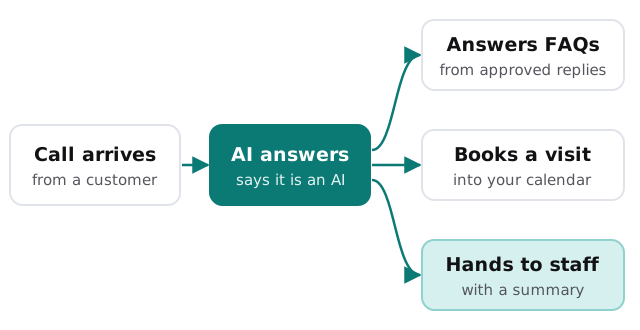
- It answers. Straight away, with a greeting in your business’s voice, and it says it’s an automated assistant.
- It listens. It works out whether this is a new enquiry, an existing customer, a supplier or a wrong number.
- It answers the easy questions. Opening hours, service areas, what to bring, how to reschedule. These come from a short list of answers you’ve approved.
- It takes the details. Name, number, address if relevant, and the reason for the call, in the order you’d ask them.
- It books or hands off. Open slots go into your calendar. Anything else goes to a person.
- It writes it up. A summary lands in your inbox, shared channel or CRM before the caller has hung up.
Calls it should hand straight to a person
Some calls aren’t for software, and a good setup knows it.
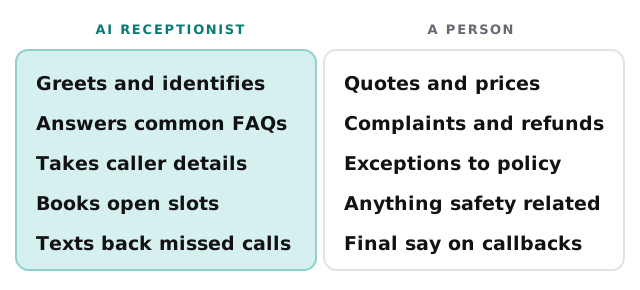
- An upset customer, or anyone who asks for a human.
- Anything involving a quote, a refund or an exception to your policy.
- Medical, legal or safety questions.
- A VIP, a supplier or a caller your team has flagged by number.
For these, the assistant doesn’t improvise. It says it’s connecting them, tries your team, and if nobody picks up it takes a message and flags it as urgent.
What the person sees afterwards
| The caller said | The AI did | Your team sees |
|---|---|---|
| “Do you work Saturdays?” | Answered from your approved hours | A line in the call log |
| “I need someone to look at a leak” | Collected address and details, offered open slots | A booked slot and a summary |
| “I want to talk to the owner” | Said it would connect them, tried your mobile | A missed-call flag with the reason |
| “What would it cost to…?” | Said a person would send a quote | A callback task with the details |
Questions to ask any provider
Whether you buy a ready-made product or have one built, ask these before you commit:
- Can I hear real recorded test calls with my own questions?
- What does it say when it doesn’t know something?
- Where do call recordings and transcripts live, and who can read them?
- Can it tell callers it’s an AI and offer to connect them to a person?
- What happens to a call if the booking system is down?
Recording and transcribing calls is regulated differently from state to state, and some states want everyone on the call to agree. If you want recordings kept, settle the greeting wording and the retention rule first, and check with your own adviser.
Texts, forms and chat too
The same assistant can answer a text-back when you miss a call, or reply to a web enquiry. You get one place where every first contact is written down, whichever door it came through. That’s also what makes AI phone answering for small business more useful than a voicemail greeting: the information goes somewhere your systems can use.
What we need from you
- The ten questions callers ask most, with the answers you’re happy to give.
- Your opening hours, service area and anything you never quote by phone.
- Which calendar bookings should land in, and which slots are fair game.
- A name and number for each kind of handoff.
We build it with a person approving what it does, test it on your real call scenarios, and you listen to those test calls before it answers a real one. If you’d like to try a ready-made assistant first, our guide to setting up Lindy for your team is a place to start.
Don’t ask whether the AI can answer every call. Ask whether every call ends with a person knowing what to do next.