Month-end is when an agency’s best people turn into data-entry clerks. Open the ad platform, export, paste into a template, open the analytics tool, export again, then try to remember what happened in week two. An AI client report generator for agencies does the pulling and the first draft, so your team spends their time on what the numbers mean.
What the month-end run looks like
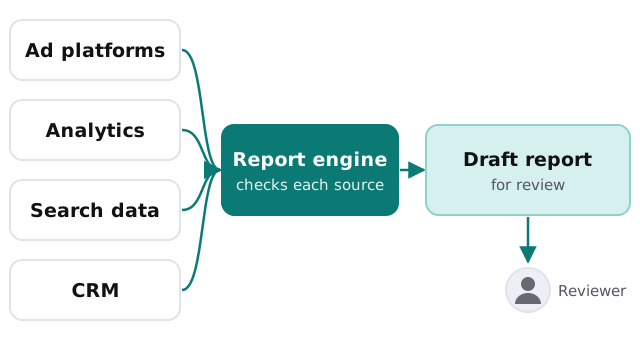
- Sources are checked. Every connected account is asked for its figures. If one is missing, the run stops and tells you which.
- Numbers are laid out. Results go into the client’s template, against the targets and last month.
- The AI drafts the story. What moved, by how much, and a plausible reason drawn from your own campaign notes.
- Oddities are flagged. A cost jump, a dropped campaign, a tracking gap. These get a note for the account manager rather than a confident guess.
- A person edits and approves. Nothing leaves without a name on it.
- The report goes out in the format the client likes, and a copy is filed.
What the AI writes and what your team adds
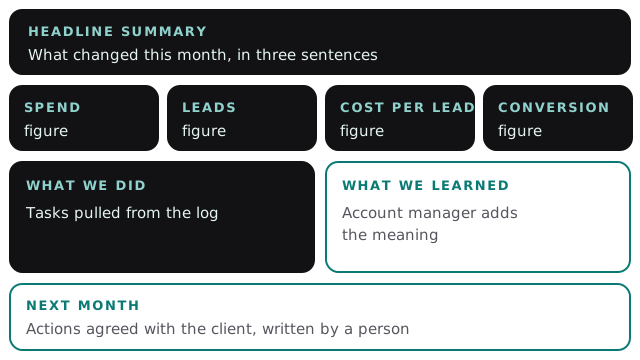
| Part of the report | The AI drafts | The account manager adds |
|---|---|---|
| Headline summary | Three sentences on what changed | The point the client cares about most this month |
| Numbers and charts | Complete, matched to targets | Which metric to lead with |
| “What we did” | A list built from your task notes | Context the notes missed |
| Explanations | Likely causes, marked as likely | What really happened, from the call |
| Next month | Suggested actions | The ones you will really commit to |
The right-hand column is why clients keep valuing the report. Anyone can supply numbers; the interpretation is the product.
Anatomy of a one-page client report
Where this goes wrong without care
- Invented explanations. A model asked “why did clicks drop?” may produce something confident and false. Ours writes “possible cause” and shows what it based it on.
- Mixed-up clients. Data for one account landing in another’s report is the worst case. Each run is scoped to one client’s connections and checked before the draft.
- Metric drift. If a platform renames or redefines a metric, the number quietly means something else. We list each definition in the template.
- Tone mismatch. A blunt report to a nervous client. Tone notes live in each template.
Here’s a Thursday in reporting week
An account manager opens the draft for a home-services client. Cost per lead rose, and the note beside it says the spend moved to a new campaign in week two, which is in the task log. She confirms that’s right, adds that the client had paused phones for a weekend, deletes one over-eager sentence, and approves. A job that eats an afternoon becomes a short review, and the report is better for it.
Agencies we’d suggest this for
- You produce more than a handful of recurring reports each month.
- Reports are mostly assembled by the same two people.
- Clients have asked for more frequent updates than you can afford to prepare.
- Your reports are good, but late.
Rather build it yourself?
A chat assistant can already turn a pasted table into a decent paragraph, and our guide to choosing an AI assistant for your team helps you pick one. What it can’t do alone is pull the data on schedule, keep clients apart and flag a broken connection. That’s the part we build.
What we need from you
Three of your best past reports, the platforms each client uses, and a read-only login for each source. We make a plan and a fixed quote, and a person approves every report the system produces.
Automate the assembling and keep the judgment. Clients are paying for what the numbers mean.