Most small businesses qualify leads in somebody’s head. The owner reads an enquiry, thinks “that’s a good one” or “that’s a time-waster”, and acts. It works until the owner is busy, away or sick, and then every enquiry waits in the same pile. AI lead qualification for small business writes down the rules you already use and applies them the minute a lead arrives, which is also how most people mean AI lead scoring for small business.
Rules first, AI second
The tool can’t know what a good lead is for you. You do, so we start there.
- List what makes a lead worth a call. A service you offer, an address you cover, a time frame, a budget that makes sense.
- List what rules one out. Outside your area, a service you don’t do, a student project, a competitor checking your prices.
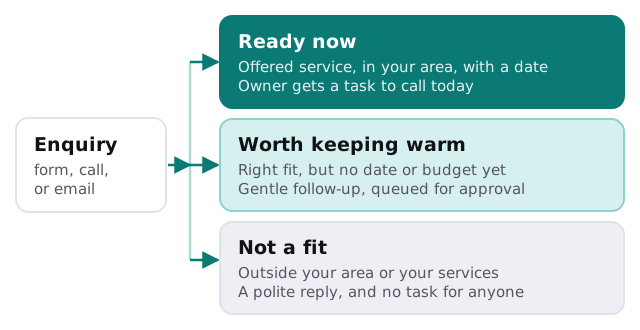
- Decide the grey zone. What happens when a lead is the right fit but gives no date? That is your “keep warm” lane.
- Write the action for each lane. Who gets told, how fast, and what is said.
The AI’s job is to read messy, free-typed enquiries against those rules. A form can tick a box. A message saying “after the baby’s here, maybe spring” needs reading.
What it looks at
| Signal | Where it comes from | What it tells you |
|---|---|---|
| Service asked for | Form field or message text | Whether it’s something you sell |
| Location | Address, postcode or message | Whether you can reach them |
| Timing | “This week”, “next spring” | How urgent the work is |
| Budget hints | A figure, or words like “tight” | Whether it can be a fit |
| Source | Ad, search, referral | How warm the lead likely is |
| Looks like spam | Odd text, links, repeats | Whether to ignore it |
Why the reasons matter more than the score
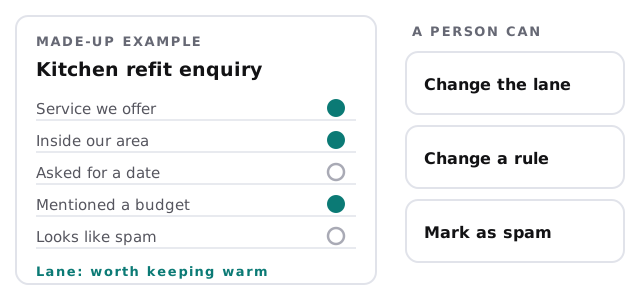
A bare number, say “72”, teaches nobody anything and invites arguments. A short list of reasons is much more useful: it’s the right service, in your area, with a date, but no budget mentioned. Anyone can read that and agree or disagree in five seconds.
Where a person stays in charge
- The rules. You write them and approve any change.
- The first conversation. The tool prepares and routes, but it doesn’t pitch or quote.
- Edge cases. A lead it isn’t sure about goes to a person and is not quietly dropped.
- Declines. Anything telling someone “no” can be reviewed before it sends.
There’s one point to take seriously. Rules can be unfair by accident. A postcode filter can screen out whole neighbourhoods you’d happily serve, so look at who’s being sorted into “not a fit” now and then.
A normal morning with it in place
Five enquiries come in overnight. Two are ready now, so they sit at the top with the reasons beside them and a task for 9am. One is right but vague, so it gets a friendly question about timing. One asks for a service you don’t offer and receives a polite referral line. One is a link-filled spam message and disappears. You started the day with two phone calls to make instead of a pile to read.
Signs your lead handling needs this
- Response time depends on who is in the office.
- You spend time on calls that were never going to be a fit.
- Good enquiries go quiet because they weren’t followed up.
- Nobody can say which lead sources produce real jobs.
Rather build it yourself?
If your leads already flow into a CRM, its built-in scoring and routing may cover the basics. Our guides to setting up HubSpot and setting up Pipedrive show where those settings live. Call us when your rules are specific, your enquiries arrive as free text, or the leads are spread over several tools.
What we need from you
- Your honest list of what a good lead and a bad lead look like.
- Twenty or so recent enquiries, with how each one turned out.
- Access to wherever enquiries land today.
We begin with a plan and a fixed quote, and a person approves the rules before the first real lead is sorted.
A good qualification tool doesn’t decide who matters. It makes sure the people who do matter get answered first.